According to manu, ‘Varna’ means classes of Jivatma, the human person, ‘Ashrama’ means stages of life and ‘dharma’ means duties to be perfomed by these classes.
There are four classes (varna) in human beings: brahmanas, kshatriyas, vaishyas and shudras. It is described that the Brahmins came out of the mouth of the Brahman, the Creator, Kshatriyas from his two arms, Vaisyas from his thighs, and the Sudras from his feet. The brahmanas class is superior to the other three.
Duties of four classes of people
- Brahmana : the teachers, clergy and the spiritual leaders.
- Kshatriya : warriors, administrators, and rulers
- Vaisya : industrialist, merchants, and traders
- Sudra : the manual labour class
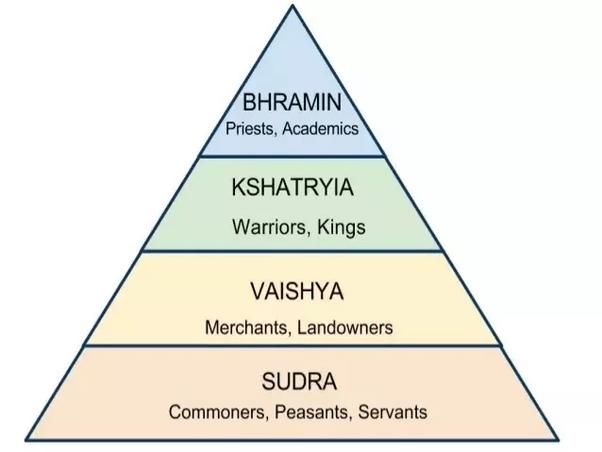
This division is according to the Guna and Karma. Guna (quality) and Karma (kind of work) determine the caste of a man. This is also supported by Lord Krishna in the Gita.
There are three gunas (quality) of human mind. The human beings according to these innate qualities fall under one of the four castes. These three gunas are sattva, rajas, and tamas.
Sattva (Real) is the noblest guna. The word ‘sattva’ means that which exists, that is real. It is the principle of goodness, happiness, bliss, luminosity and knowledge. The Brahmins are those in whom the sattva or sattvika qualities are very much dominant.
Rajas (Foulness) is the principle of activity, energy, motion. It leads to a life of feverish enjoyment and restless effort. Those people in whom sattva and rajas qualities are powerful are called Kshatriyas.
Tamas (Darkness) is the principle of inertia, matter, resistance, passivity, negativity etc. Those people in whom rajas and tamas qualities are predominant, are called Vaisyas. And those people in whom tamas is very dominant are called Sudras.
In Bhagavad Gita IV.13, we read that the four castes were emanated by me, by the different distribution of energies and actions; know me to be the author of them.
In Mahabharata, Vanaparva c1 xxx 21, 25, 26, we read, a man is called a Brahmana, when in him there are truthfulness, forgiveness, good conduct, gentleness, austerity and mercy. If they are not found in him, he is not a Brahmana, he is regarded as a Sudra, so also if these qualities are found in a Sudra, he is not a Sudra but a Brahmana.
The famous Shloka in Mahabharata, Vanaparva, ccc xiii 108 says, “not birth, nor Samskaras, nor study of Vedas, nor ancestry are the causes for Brahmanhood, conduct alone is verily the cause of Brahmanhood. So anyone can attain Brahmanhood by their conduct. For example, Valmiki Vyasa, Vasistha, and Narada who were all the children of Sudras.
 Philosophy