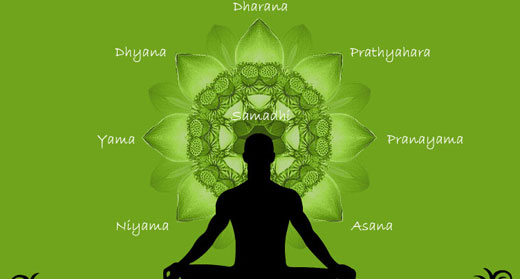
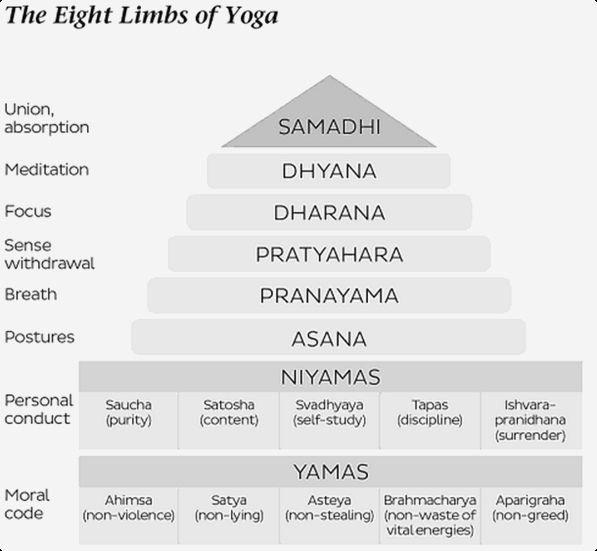
Yoga is for controlling over the body, the senses and the mind. A sound mind needs a sound body. Sensual attachment and passions distract body as well as the mind. They must be conquered. To overcome them, Yoga gives us the Eightfold Path of Discipline or the Ashtanga Yoga. Those are Yama, Niyama, Asana, Pranayama, Prathyahara, Dharana, Dhyana and Samadhi.
1. Yama (Self-restrained)
Yamas are five rules of behaviour which purify one’s mind and behaviour.
i) Non-violence (ahimsa): not to hurt anyone including animals, plants.
ii) Truth (satya): to speak truth.
iii) Non-stealing (asteya): not to steal
iv) Celibacy (brahmacarya): to control of attachment in the enjoyment of the senses.
v) Non-possession (aparigraha): not to accept any unnecessary things or collect it.
All the above mentioned yamas are necessary for the concentration of chitta.
2. Niyama (Positive rules of conduct)
Another important step in Yoga is Niyama or following the rules of good conduct. These Niyamas are five which are as follows:
i) Purity (sauca): purity of body and mind.
ii) Contentment (santosa): satisfaction in whatever is attained.
iii) Right aspiration (tapas): the practice of tolerance of cold and heat.
iv) Study of Philosophical texts (svadhyaya): reading of religious scriptures.
v) Devotion to God (Iswarapranidhana): to remember God and to surrender oneself to Him.
3. Asana
The third step in yoga is Asana or posture. It means steady and comfortable posture for meditation. The posture is helpful for concentration.
4. Pranayama
It means control of breath and deals with regulation of inhalation, retention and exhalation of breath. The regulating of breathing process helps considerably to bring the mind under control.
5. Prathyahara
In Pratyahara we withdraw the senses from their external objects and turn them inward. We have five main senses which are sight, smell, hearing, touch and taste. Our senses have a natural tendency to go to outward objects and they perceive the facts of Prakrti. In Yoga we train our sense organs to remain quiet without outer stimulation
The above five steps are called external aids to Yoga (bahiranga sadhana) while the remaining three which follow are called internal aids (antaranga sadhana).
6. Dharana
Dharana is focusing of mind on a particular object. Generally the mind is easily disturbed. It passes from objects to objects in a matter of seconds. The mind is to be tied to a particular object in order that it may become steady and unmoving. Any object like the tip of the nose or the midpoint of the eye-brows or the image of the deity may be chosen for meditating upon in this stage.
7. Dhyana
Dhyana culminates in Samadhi. Uninterrupted meditation without an object is called dhyana. Concentration (dharana) leads to the state of meditation. The goal of meditation is not unconsciousness or nothingness. It is heightened awareness and oneness with the universe.
8. Samadhi
The ultimate goal of the eightfold path to yoga is samadhi or absolute bliss. This is pure contemplation, superconsciousness, in which you and the universe are one. Only when one comes out of Samadhi one realizes that it was a state of Samadhi where sense of time and place was totally absent.
Yoga generates certain supra-normal powers. But they should be avoided and attention should be fixed only on the liberation which is the end of human life. The ideal is Kaivalya, the absolute independence and eternal and free life of the Purusa, free from Prakrti.
EIGHT SIDDHIS
According to Yoga philosophy, the Yogis attain various siddhis by the practice of the path of Yoga. These powers are mainly of eight types and hence called Ashta siddhi or Ashta Aisvarya:
(1) Anima– the power to disappear.
(2) Laghima– the power to fly away.
(3) Mahima– the power to become big like mountains.
(4) Prapti– the power to secure whatever is desired.
(5) Prakamya-the power by which all the impediments in the will removed.
(6) Vashitwa– the power by which all the living beings can be conquered.
(7) Eshitwa– the power by which one attains absolute mastery on all physical objects.
(8) Yatrakamavasayitwa– the power by which all the desires are fulfilled.
The above mentioned eight siddhis can be used according to the wish of the Yogi. The ultimate end of the Yoga is not the attainment of these powers, but the realisation of Moksa. Thus, Yoga is a combination of practical physical development and discipline with a mystical objective which is its ultimate purpose.
 Philosophy