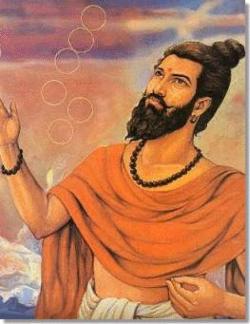
What is Atom?
According to Vaisesika, atom is the minutest particle of matter. It may not be further divisible. This indivisible particle is called an atom (paramanu). All physical things are made by the combination of these atoms. So the creation means the combination of atoms in different proportions and destruction means the dissolution of such combination. The material cause of the universe is neither produced nor destroyed. Atoms are eternal.
Kinds of Atoms
Four kinds of atoms exists; earth, water, fire and air. Ether or akasha is the medium for the combinations of the atoms. The atoms differ from one another both in quantity and in quality. During dissolution, they remain inactive. Motion is imparted to them by the unseen power (adrsta) of merit (dharma) and demerit (adharma) which resides in the individual souls and wants to fructify in the form of enjoyment or suffering. Atoms are supra sensible.
On the other hand, all composite objects are non-eternal. Because these objects are constituted by the combination of atoms. It can be destroyed through their separation. The first combination of two atoms is called a dvyanuka or dyad, and a combination of three dyads (dvyanukas) is called a tryanuka or triad.
God and Karma
All the finite objects are composed of the four kinds of atoms. The universe is a system of physical things and living beings. All these exist and interact with one another, in time, space and akasa. Vaisesika also admits the reality of the spiritual substancess and God, and also admits the law of karma. The atoms are the material cause of the world of which God is the efficient cause.
 Philosophy